Next: 5 Photoionization modeling Up: Observations and three-dimensional photoionization Previous: 3 Kinematics
The derived electron temperatures ( ) and densities (
 ) are listed in Table 5, together with the ionization potential required to create the emitting ions.
We obtained
and
from temperature-sensitive and density-sensitive emission lines by solving the equilibrium equations of level populations for a multilevel atomic model using EQUIB code (Howarth & Adams, 1981). The atomic data sets used for our plasma diagnostics from collisionally excited lines (CELs), as well as for abundances derived from CELs, are given in Table 4. The diagnostics procedure to determine temperatures and densities from CELs is as follows: we assume a representative initial electron temperature of 10000K in order to derive
from
) are listed in Table 5, together with the ionization potential required to create the emitting ions.
We obtained
and
from temperature-sensitive and density-sensitive emission lines by solving the equilibrium equations of level populations for a multilevel atomic model using EQUIB code (Howarth & Adams, 1981). The atomic data sets used for our plasma diagnostics from collisionally excited lines (CELs), as well as for abundances derived from CELs, are given in Table 4. The diagnostics procedure to determine temperatures and densities from CELs is as follows: we assume a representative initial electron temperature of 10000K in order to derive
from  S II
S II![$ ]$](img10.png) line ratio; then
is derived from
N II
line ratio in conjunction with the mean density derived from the previous step. The calculations are iterated to give self-consistent results for
and
. The correct choice of electron density and temperature is important for the abundance determination.
line ratio; then
is derived from
N II
line ratio in conjunction with the mean density derived from the previous step. The calculations are iterated to give self-consistent results for
and
. The correct choice of electron density and temperature is important for the abundance determination.
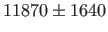
We see that the PN Abell 48 has a mean temperature of
 N II
N II
![$ ])=6980 \pm 930 $](img208.png) K, and a mean electron density of
K, and a mean electron density of
 S II
S II
![$ ])=750 \pm 200$](img210.png) cm
cm , which are in reasonable agreement with
N II
, which are in reasonable agreement with
N II
![$ ])=7\,200 \pm 750$](img212.png) K and
S II
K and
S II
![$ ])=1000 \pm 130$](img213.png) cm
found by Todt et al. (2013). The uncertainty on
N II
cm
found by Todt et al. (2013). The uncertainty on
N II![$ ])$](img214.png) is order of
is order of  percent or more, due to the weak flux intensity of [N II]
  5755, the recombination contribution, and high interstellar extinction. Therefore, we adopted the mean electron temperature from our photoionization model for our CEL abundance analysis.
| Ion | Transition probabilities | Collision strengths |
N
|
Bell et al. (1995) | Stafford et al. (1994) |
|
|
Zeippen (1987) | Pradhan et al. (2006) |
O
|
Storey & Zeippen (2000) | Lennon & Burke (1994) |
|
|
Landi & Bhatia (2005) | McLaughlin & Bell (2000) |
|
|
Mendoza & Zeippen (1982) | Ramsbottom et al. (1996) |
|
S
|
Mendoza & Zeippen (1982) | Tayal & Gupta (1999) |
| Huang (1985) | ||
|
|
Biémont & Hansen (1986) | Galavis et al. (1995) |
| Ion | Recombination coefficient | Case |
|
H
|
Storey & Hummer (1995) | B |
|
|
Porter et al. (2013) | B |
|
|
Davey et al. (2000) | B |
Table 5 also lists the derived HeI temperatures, which are lower than the CEL temperatures, known as the ORL-CEL temperature discrepancy problem in PNe (see e.g. Liu et al., 2000; Liu et al., 2004b).
To determine the electron temperature from the HeI
 5876, 6678 and 7281 lines, we used the emissivities of He I lines by Smits (1996), which also include the temperature range of
 K. We derived electron temperatures of
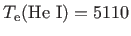 K and
K and
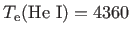 K from the flux ratio HeI
7281/5876 and
7281/6678, respectively. Similarly, we got
K from the flux ratio HeI
7281/5876 and
7281/6678, respectively. Similarly, we got
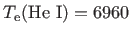 K for HeI
7281/5876 and
K for HeI
7281/5876 and
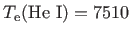 K for
7281/6678 from the measured nebular spectrum by Todt et al. (2013).
K for
7281/6678 from the measured nebular spectrum by Todt et al. (2013).
| Ion | Diagnostic | I.P.(eV) |

|
Ref. |
|
N II
|

|
14.53 |

|
D13 |

|
T13 | |||
|
O III
|

|
35.12 |
|
T13 |
| HeI |

|
24.59 |

|
D13 |

|
T13 | |||
| HeI |

|
24.59 |

|
D13 |

|
T13 | |||

|
||||
|
S II
|

|
10.36 |

|
D13 |

|
T13 |
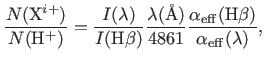
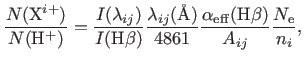
Using the effective recombination coefficients, we determine ionic abundances, X /H
, from the measured intensities of ORLs as follows:
/H
, from the measured intensities of ORLs as follows:
 is the intrinsic line flux of the emission line
emitted by ion
is the intrinsic line flux of the emission line
emitted by ion
 ,
,
 is the intrinsic line flux of H
 ,
,
 the effective recombination coefficient of H
, and
the effective recombination coefficient of H
, and
 the effective recombination coefficient for the emission line
.
the effective recombination coefficient for the emission line
.
Abundances of helium and carbon from ORLs are given in Table 6. We derived the ionic and total helium abundances from HeI
4471,
5876 and
6678 lines. We assumed the Case B recombination for the HeI lines (Porter et al., 2013; Porter et al., 2012). We adopted an electron temperature of
 K from HeI lines, and an electron density of
 cm
. We averaged the He
/H
ionic abundances from the HeI
4471,
5876 and
6678 lines with weights of 1:3:1, roughly the intrinsic intensity ratios of these three lines. The total He/H abundance ratio is obtained by simply taking the sum of He
/H
and He
/H
. However, He
/H
is equal to zero, since HeII
4686 is not present. The C
cm
. We averaged the He
/H
ionic abundances from the HeI
4471,
5876 and
6678 lines with weights of 1:3:1, roughly the intrinsic intensity ratios of these three lines. The total He/H abundance ratio is obtained by simply taking the sum of He
/H
and He
/H
. However, He
/H
is equal to zero, since HeII
4686 is not present. The C ionic abundance is obtained from C II
6462 and
7236 lines.
ionic abundance is obtained from C II
6462 and
7236 lines.
| Ion |
(Å) |
Mult | Value

|
He
|
4471.50 | V14 | 0.141 |
| 5876.66 | V11 | 0.121 | |
| 6678.16 | V46 | 0.115 | |
| Mean | 0.124 | ||
|
He
|
4685.68 | 3.4 | 0.0 |
| He/H | 0.124 | ||
| C
|
6461.95 | V17.40 | 3.068( )
) |
| 7236.42 | V3 | 1.254(
) |
|
| Mean | 2.161(
) |
K and
 .
.
We determined abundances for ionic species of N, O, Ne, S and Ar from CELs. To deduce ionic abundances, we solve the statistical equilibrium equations for each ion using EQUIB code, giving level population and line sensitivities for specified
cm
and
 K adopted according to our photoionization modeling. Once
the equations for the population numbers are solved, the ionic abundances, X
/H
, can be derived from the observed line intensities of CELs as follows:
K adopted according to our photoionization modeling. Once
the equations for the population numbers are solved, the ionic abundances, X
/H
, can be derived from the observed line intensities of CELs as follows:
 is the dereddened flux of the emission line
 emitted by ion
following the transition from the upper level
emitted by ion
following the transition from the upper level  to the lower level
  ,
the dereddened flux of H
,
,
the dereddened flux of H
,
 the effective recombination coefficient of H
,
the effective recombination coefficient of H
,  the Einstein spontaneous transition probability of the transition,
  the fractional population of the upper level
, and
is the electron density.
the fractional population of the upper level
, and
is the electron density.
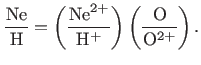
Total elemental and ionic abundances of nitrogen, oxygen, neon, sulfur and argon from CELs are presented in Table 7. Total elemental abundances are derived from ionic abundances using the ionization correction factors ( ) formulas given by Kingsburgh & Barlow (1994). The total O/H abundance ratio is obtained by simply taking the sum of the O
 /H
derived from [O II]
3726,3729 doublet, and the O
/H
derived from [O III]
4959,5007 doublet, since HeII
4686 is not present, so O
/H
derived from [O II]
3726,3729 doublet, and the O
/H
derived from [O III]
4959,5007 doublet, since HeII
4686 is not present, so O /H
is negligible.
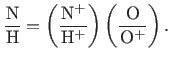
The total N/H abundance ratio was calculated from the N
/H
ratio derived from the [N II]
6548,6584 doublet, correcting for the unseen N
/H
using,
/H
is negligible.
The total N/H abundance ratio was calculated from the N
/H
ratio derived from the [N II]
6548,6584 doublet, correcting for the unseen N
/H
using,
/H
is derived from [Ne III]
3869 line. Similarly, the unseen Ne
/H
is corrected for, using
 |
(4) |
/H
from the [S II]
6716,6731 doublet and
S
/H
from the [S III]
9069 line. The total sulfur abundance is corrected for the unseen stages of ionization using
/H
. The total argon abundance is obtained by assuming Ar
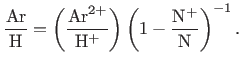
/Ar = N
/N:
 , so the derived elemental argon may be underestimated.
![\includegraphics[width=1.7in]{figures/fig9_AbHeII.eps}](img265.png)
![\includegraphics[width=1.7in]{figures/fig9_AbNIICEL.eps}](img266.png) ![\includegraphics[width=1.7in]{figures/fig9_AbOIIICEL.eps}](img267.png) ![\includegraphics[width=1.7in]{figures/fig9_AbSIICEL.eps}](img268.png)
|
Fig.4 shows the spatial distribution of ionic abundance ratio He
/H
, N
/H
, O
/H
and S
/H
derived for given
 K and
cm
K and
cm . We notice that both O
/H
and He
/H
are very high over the shell, whereas N
/H
and S
/H
are seen at the edges of the shell. It shows obvious results of the ionization sequence from the
highly inner ionized zones to the outer low ionized regions.
. We notice that both O
/H
and He
/H
are very high over the shell, whereas N
/H
and S
/H
are seen at the edges of the shell. It shows obvious results of the ionization sequence from the
highly inner ionized zones to the outer low ionized regions.
| Ion |
(Å) |
Mult | Value
|
|
N
|
6548.10 | F1 | 1.356( )
) |
| 6583.50 | F1 | 1.486(
) |
|
| Mean | 1.421(
) |
||
|
(N) |
3.026 | ||
| N/H | 4.299(
) |
||
| O
|
3727.43 | F1 | 5.251(
) |
|
O
|
4958.91 | F1 | 1.024( )
) |
| 5006.84 | F1 | 1.104(
) |
|
| Average | 1.064(
) |
||
|
(O) |
1.0 | ||
| O/H | 1.589(
) |
||
| Ne
|
3868.75 | F1 | 4.256(
) |
|
(Ne) |
1.494 | ||
| Ne/H | 6.358(
) |
||
| S
|
6716.44 | F2 | 4.058( )
) |
| 6730.82 | F2 | 3.896(
) |
|
| Average | 3.977(
) |
||
|
S
|
9068.60 | F1 | 5.579( )
) |
|
(S) |
1.126 | ||
| S/H | 6.732(
) |
||
| Ar
|
7135.80 | F1 | 9.874(
) |
|
(Ar) |
1.494 | ||
| Ar/H | 1.475(
) |
K and
.
![$\displaystyle \footnotesize \frac{{\rm S}}{{\rm H}}=\left(\frac{{\rm S}^{+}}{{\...
...} \right) \left[1-\left(1-\frac{{\rm O}^{+}}{{\rm O}}\right)^{3}\right]^{-1/3}.$](img262.png)