Next: 7 Conclusion Up: Observations and three-dimensional ionization Previous: 5 Ionic and total
![\includegraphics[width=2.2in]{figures/fig14_isodensity.eps}](img303.png)
|
We used the 3 D photoionization code MOCASSIN (version 2.02.67) to study the ring
of the PN SuWt 2. The code,
described in detail by Ercolano et al. (2003a); Ercolano et al. (2005); Ercolano et al. (2008), applies a Monte Carlo method to solve
self-consistently the 3 D radiative transfer of the stellar and diffuse field in a gaseous and/or dusty nebula having asymmetric/symmetric density distribution and inhomogeneous/homogeneous chemical abundances, so it can deal with any structure and morphology. It also allows us to include multiple ionizing sources located in any arbitrary position in the nebula. It produces several outputs that can be compared with observations, namely a nebular emission-line spectrum, projected emission-line maps, temperature structure and fractional ionic abundances. This code has already been used for a number of axisymmetric PNe, such as NGC 3918 (Ercolano et al., 2003b), NGC 7009 (Gonçalves et al., 2006), NGC 6781 (Schwarz & Monteiro, 2006), NGC 6302 (Wright et al., 2011) and NGC 40 (Monteiro & Falceta-Gonçalves, 2011).
To save computational time, we began with the gaseous model of a
 Cartesian grid, with the ionizing source being placed in a corner in order to take advantage of the axisymmetric morphology used.
This initial low-resolution grid helped us explore the parameter space of the
photoionization models, namely ionizing source, nebula abundances and distance. Once we found the best fitting model, the final simulation was done using a density distribution model constructed in
Cartesian grid, with the ionizing source being placed in a corner in order to take advantage of the axisymmetric morphology used.
This initial low-resolution grid helped us explore the parameter space of the
photoionization models, namely ionizing source, nebula abundances and distance. Once we found the best fitting model, the final simulation was done using a density distribution model constructed in
 cubic grids with the same size, corresponding to
14175 cubic cells of length 1 arcsec each.
Due to computational restrictions on time, we did not run any model with higher number of cubic cells.
The atomic data set used for the photoionization modelling,
includes the CHIANTI database (version 5.2; Landi et al., 2006), the improved coefficients of the H I, He I and He II free-bound continuous emission (Ercolano & Storey, 2006) and the photoionization cross-sections and ionic ionization energies (Verner et al., 1993; Verner & Yakovlev, 1995).
cubic grids with the same size, corresponding to
14175 cubic cells of length 1 arcsec each.
Due to computational restrictions on time, we did not run any model with higher number of cubic cells.
The atomic data set used for the photoionization modelling,
includes the CHIANTI database (version 5.2; Landi et al., 2006), the improved coefficients of the H I, He I and He II free-bound continuous emission (Ercolano & Storey, 2006) and the photoionization cross-sections and ionic ionization energies (Verner et al., 1993; Verner & Yakovlev, 1995).
![\includegraphics[width=6.5in]{figures/fig17_nlte.eps}](img308.png)
|
The modelling procedure consists of an iterative process during which the calculated H luminosity
 (ergs
(ergs ), the ionic abundance ratios (i.e. He
 /He
/He , N
/H
, O
/H
) and
the flux intensities of some important lines, relative to H
(such as He II
, N
/H
, O
/H
) and
the flux intensities of some important lines, relative to H
(such as He II  4686,
4686,  N II
N II![$ ]$](img3.png) 6584 and
O III
5007) are compared with
the observations. We performed a maximum of 20 iterations per
simulation and the minimum convergence level achieved was 95%.
The free parameters included distance and stellar characteristics, such as
luminosity and effective temperature. Although we adopted the density
and abundances derived in Sections 4 and 5, we gradually scaled up/down the
abundances in Table 5 until the
observed emission-line fluxes were reproduced by the model. Due to the
lack of infrared data we did not model the dust component of this
object. We notice however some variations among the values of
6584 and
O III
5007) are compared with
the observations. We performed a maximum of 20 iterations per
simulation and the minimum convergence level achieved was 95%.
The free parameters included distance and stellar characteristics, such as
luminosity and effective temperature. Although we adopted the density
and abundances derived in Sections 4 and 5, we gradually scaled up/down the
abundances in Table 5 until the
observed emission-line fluxes were reproduced by the model. Due to the
lack of infrared data we did not model the dust component of this
object. We notice however some variations among the values of
 between the ring and the inner region in
Table 2. It means that all of the observed reddening may not be due to the ISM.
We did not include the outer bipolar lobes in our model,
since the geometrical dilution reduces radiation beyond the ring.
The faint bipolar lobes projected on the sky are far from the UV radiation field, and are dominated by the photodissociation region (PDR). There is a
transition region between the photoionized region and PDR. Since MOCASSIN cannot currently treat a PDR fully, we are unable to model the region beyond the ionization front, i.e. the ring.
This low-density PN is extremely faint, and not highly optically thick (i.e. some UV radiations escape from the ring), so it is difficult to estimate a stellar luminosity from the total nebula H
intrinsic line flux.
The best-fitting model depends upon the effective temperature (
between the ring and the inner region in
Table 2. It means that all of the observed reddening may not be due to the ISM.
We did not include the outer bipolar lobes in our model,
since the geometrical dilution reduces radiation beyond the ring.
The faint bipolar lobes projected on the sky are far from the UV radiation field, and are dominated by the photodissociation region (PDR). There is a
transition region between the photoionized region and PDR. Since MOCASSIN cannot currently treat a PDR fully, we are unable to model the region beyond the ionization front, i.e. the ring.
This low-density PN is extremely faint, and not highly optically thick (i.e. some UV radiations escape from the ring), so it is difficult to estimate a stellar luminosity from the total nebula H
intrinsic line flux.
The best-fitting model depends upon the effective temperature (
 ) and the stellar luminosity (
 ), though both are related to the evolutionary stage of the central star. Therefore, it is necessary to restrict our stellar parameters to the evolutionary tracks of the post-AGB stellar models, e.g., `late thermal pulse', `very late thermal pulse' (VLTP), or `asymptotic giant branch final thermal pulse' (see e.g. Miller Bertolami et al., 2006; Herwig, 2001; Schönberner, 1983; Blöcker, 1995; Iben & Renzini, 1983; Vassiliadis & Wood, 1994). To constrain
and
, we employed a set of evolutionary tracks for initial masses between
), though both are related to the evolutionary stage of the central star. Therefore, it is necessary to restrict our stellar parameters to the evolutionary tracks of the post-AGB stellar models, e.g., `late thermal pulse', `very late thermal pulse' (VLTP), or `asymptotic giant branch final thermal pulse' (see e.g. Miller Bertolami et al., 2006; Herwig, 2001; Schönberner, 1983; Blöcker, 1995; Iben & Renzini, 1983; Vassiliadis & Wood, 1994). To constrain
and
, we employed a set of evolutionary tracks for initial masses between  and
and
 calculated by Blöcker (1995, Tables 3-5). Assuming a density model shown in Fig. 8, we first estimated the effective temperature and luminosity of the central star by matching the H
luminosity
calculated by Blöcker (1995, Tables 3-5). Assuming a density model shown in Fig. 8, we first estimated the effective temperature and luminosity of the central star by matching the H
luminosity
 and the ionic helium abundance ratio He
/He
with the values derived from observation and empirical analysis. Then, we scaled up/down abundances to get the best values for ionic abundance ratios and the flux intensities.
and the ionic helium abundance ratio He
/He
with the values derived from observation and empirical analysis. Then, we scaled up/down abundances to get the best values for ionic abundance ratios and the flux intensities.
The dense torus used for the ring was developed from the higher spectral resolution kinematic model of Jones et al. (2010) and our plasma diagnostics (Section 4).
Although the density cannot be more than the low-density limit of
 cm
cm due to the [S II]
 6716/6731 line ratio of
 , it was slightly adjusted to produce the total H
Balmer intrinsic line flux
, it was slightly adjusted to produce the total H
Balmer intrinsic line flux
 derived for the ring and interior structure or the H
luminosity
derived for the ring and interior structure or the H
luminosity
 at the specified distance
  . The three-dimensional density distribution used for the torus and interior structure is shown in Fig. 8. The central star is located in the centre of the torus. The torus has a radius of
  arcsec from its centre to the centre of the tube (1 arcsec is equal to
 pc based on the best-fitting photoionization models). The radius of the tube of the ring is
  arcsec. The hydrogen number density of the torus is taken to be homogeneous and equal to
 cm
cm .
Smith et al. (2007) studied similar objects, including SuWt 2, and found that the ring itself can be a swept-up thin disc, and the interior of the
ring is filled with a uniform equatorial disc. Therefore, inside the ring, there is a less dense oblate spheroid with a homogeneous density of 50 cm
, a semimajor axis of
.
Smith et al. (2007) studied similar objects, including SuWt 2, and found that the ring itself can be a swept-up thin disc, and the interior of the
ring is filled with a uniform equatorial disc. Therefore, inside the ring, there is a less dense oblate spheroid with a homogeneous density of 50 cm
, a semimajor axis of  arcsec and a semiminor axis of
arcsec. The H number density of the oblate spheroid is chosen to match the total
and be a reasonable fit for H
arcsec and a semiminor axis of
arcsec. The H number density of the oblate spheroid is chosen to match the total
and be a reasonable fit for H /H
/H compared to the empirical results. The dimensions of the model were estimated from the kinematic model of Jones et al. (2010) with an adopted inclination of 68
 .
The distance was estimated over a range 2.1-2.7 kpc, which
corresponds to a reliable range based on the H
.
The distance was estimated over a range 2.1-2.7 kpc, which
corresponds to a reliable range based on the H surface brightness-radius relation of Frew & Parker (2006) and Frew (2008). The distance was allowed to vary to find
the best-fitting model. The value of 2.3 kpc adopted in this work
yielded the best match to the observed H
luminosity and it is also in very good agreement with Exter et al. (2010).
surface brightness-radius relation of Frew & Parker (2006) and Frew (2008). The distance was allowed to vary to find
the best-fitting model. The value of 2.3 kpc adopted in this work
yielded the best match to the observed H
luminosity and it is also in very good agreement with Exter et al. (2010).
All major contributors to the thermal balance of the gas were included
in our model. We used a homogeneous elemental abundance distribution consisting of eight elements.
The initial abundances of He, N, O, Ne, S and Ar were taken from the
observed empirically derived total abundances listed in
Table 5. The abundance of C was a
free parameter, typically varying between
 and
and
 in PNe. We initially used the typical value of
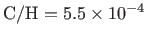 (Kingsburgh & Barlow, 1994), and adjusted it to preserve the thermal balance of the nebula.
We kept the
initial abundances fixed while the stellar parameters and distance were
being scaled to produce the best fit for the H
luminosity and
He
/He
ratio, and then we gradually varied them to obtain
the finest match between the predicted and observed emission-line
fluxes, as well as ionic abundance ratios from the empirical analysis.
(Kingsburgh & Barlow, 1994), and adjusted it to preserve the thermal balance of the nebula.
We kept the
initial abundances fixed while the stellar parameters and distance were
being scaled to produce the best fit for the H
luminosity and
He
/He
ratio, and then we gradually varied them to obtain
the finest match between the predicted and observed emission-line
fluxes, as well as ionic abundance ratios from the empirical analysis.
The flux intensity of He II
4686 Å and
the He
/He
ratio highly depend on the temperature and
luminosity of the central star. Increasing either
or
or both increases the He
/He
ratio. Our method was to match the He
/He
ratio, and
then scale the He/H abundance ratio to produce the observed intensity of He II
4686 Å.
The abundance ratio of oxygen was adjusted to match the intensities of
O III
4959,5007 and to a lesser degree
O II
3726, 3729. In particular, the intensity of the
O II
doublet is unreliable due to
the contribution of recombination and the uncertainty of about 30% at the
extreme blue of the WiFeS.
So we gradually modified the abundance ratio O/H until the best match
for
O III
4959,5007 and
O
/H
was produced. The abundance ratio of nitrogen
was adjusted to match the intensities of
N II
6548,6584 and N
/H
. Unfortunately, the
weak
N II
5755 emission line does not have a high S/N ratio in our data.
The abundance ratio of sulphur was adjusted to match the intensities of
S III
9069. The intensities of
S II
6716,6731 and S
/H calculated by our models are about seven and ten times lower than those values derived from observations and empirical analysis, respectively. The intensity of
S II
6716,6731 is largely increased due to shock-excitation effects.
![\includegraphics[width=3.5in]{figures/fig15_hr_1.eps}](img326.png) ![\includegraphics[width=3.5in]{figures/fig15_hr_2.eps}](img327.png)
|
Finally, the differences between the total abundances from our
photoionization model and those derived from our empirical analysis
can be explained by the  errors resulting from a non-spherical
morphology and properties of the exciting
source. Gonçalves et al. (2012) found that additional corrections are
necessary compared to those introduced by Kingsburgh & Barlow (1994) due
to geometrical effects. Comparison with results from photoionization
models shows that the empirical analysis overestimated the neon
abundances. The neon abundance must be lower than the value found by
the empirical analysis to reproduce the observed intensities of
Ne III
3869,3967. It means that the
(Ne) of
Kingsburgh & Barlow (1994) overestimates the unseen ionization
stages. Bohigas (2008) suggested to use an alternative empirical method for correcting unseen ionization stages of neon.
It is clear that with the typical Ne
/Ne=O
/O assumption of the
method, the neon total abundance is overestimated by the empirical analysis.
errors resulting from a non-spherical
morphology and properties of the exciting
source. Gonçalves et al. (2012) found that additional corrections are
necessary compared to those introduced by Kingsburgh & Barlow (1994) due
to geometrical effects. Comparison with results from photoionization
models shows that the empirical analysis overestimated the neon
abundances. The neon abundance must be lower than the value found by
the empirical analysis to reproduce the observed intensities of
Ne III
3869,3967. It means that the
(Ne) of
Kingsburgh & Barlow (1994) overestimates the unseen ionization
stages. Bohigas (2008) suggested to use an alternative empirical method for correcting unseen ionization stages of neon.
It is clear that with the typical Ne
/Ne=O
/O assumption of the
method, the neon total abundance is overestimated by the empirical analysis.
![\includegraphics[width=2.3in]{figures/fig16_Te_volume.eps}](img328.png) ![\includegraphics[width=2.3in]{figures/fig16_Ne_volume.eps}](img329.png) ![\includegraphics[width=2.3in]{figures/fig16_HeI_volume.eps}](img330.png)
![\includegraphics[width=2.3in]{figures/fig16_HeII_volume.eps}](img331.png) ![\includegraphics[width=2.3in]{figures/fig16_NI_volume.eps}](img332.png) ![\includegraphics[width=2.3in]{figures/fig16_NII_volume.eps}](img333.png)
![\includegraphics[width=2.3in]{figures/fig16_OI_volume.eps}](img334.png) ![\includegraphics[width=2.3in]{figures/fig16_OII_volume.eps}](img335.png) ![\includegraphics[width=2.3in]{figures/fig16_OIII_volume.eps}](img336.png)
![\includegraphics[width=2.3in]{figures/fig16_NeII_volume.eps}](img337.png) ![\includegraphics[width=2.3in]{figures/fig16_ArII_volume.eps}](img338.png) ![\includegraphics[width=2.3in]{figures/fig16_ArIII_volume.eps}](img339.png)
|
The central ionizing source of SuWt 2 was modelled using different
non-local thermodynamic equilibrium (NLTE; Rauch, 2003) model
atmospheres listed in Table 6, as they
resulted in the best fit of the nebular emission-line
fluxes. Initially, we tested a set of blackbody fluxes with the effective temperature (
) ranging from  to
to  K, the stellar luminosity compared to that of the Sun (
 ) ranging from
50-800 and different evolutionary tracks (Blöcker, 1995). A
blackbody spectrum provides a rough estimate of the ionizing source
required to photoionize the PN SuWt 2. The assumption of
a blackbody spectral energy distribution (SED) is not quite correct as
indicated by Rauch (2003). The strong differences between a blackbody
SED and a stellar atmosphere are mostly noticeable at energies higher
than 54 eV (He II ground state). We thus successively used the
NLTE Tübingen Model-Atmosphere
Fluxes Package5 (TMAF; Rauch, 2003) for hot compact stars.
We initially chose the stellar temperature and luminosity (gravity) of the best-fitting blackbody model, and changed them to get the best observed ionization properties of the nebula.
) ranging from
50-800 and different evolutionary tracks (Blöcker, 1995). A
blackbody spectrum provides a rough estimate of the ionizing source
required to photoionize the PN SuWt 2. The assumption of
a blackbody spectral energy distribution (SED) is not quite correct as
indicated by Rauch (2003). The strong differences between a blackbody
SED and a stellar atmosphere are mostly noticeable at energies higher
than 54 eV (He II ground state). We thus successively used the
NLTE Tübingen Model-Atmosphere
Fluxes Package5 (TMAF; Rauch, 2003) for hot compact stars.
We initially chose the stellar temperature and luminosity (gravity) of the best-fitting blackbody model, and changed them to get the best observed ionization properties of the nebula.
Fig. 9 shows the NTLE model atmosphere fluxes used
to reproduce the observed nebular emission-line spectrum by our
photoionization models. We first used a hydrogen-rich model atmosphere with an
abundance ratio of H:He=8:2 by mass,  (cgs), and
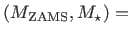
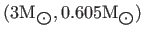
 K (Model 1), corresponding to the final stellar mass of
 and the zero-age main sequence (ZAMS) mass of
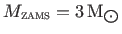 , where
 is the solar mass. However, its post-AGB age (
 ) of 7500yr,
as shown in Fig. 10 (left-hand panel), is too short to
explain the nebula's age. We therefore moved to a hydrogen-deficient model, which includes Wolf-Rayet central stars ([WC]) and the hotter PG 1159 stars.
[WC]-type central stars are mostly associated with carbon-rich nebula (Zijlstra et al., 1994). The evolutionary tracks of the VLTP for H-deficient models, as shown in Fig.10 (right-hand panel), imply a surface gravity of
) of 7500yr,
as shown in Fig. 10 (left-hand panel), is too short to
explain the nebula's age. We therefore moved to a hydrogen-deficient model, which includes Wolf-Rayet central stars ([WC]) and the hotter PG 1159 stars.
[WC]-type central stars are mostly associated with carbon-rich nebula (Zijlstra et al., 1994). The evolutionary tracks of the VLTP for H-deficient models, as shown in Fig.10 (right-hand panel), imply a surface gravity of
 for given
and
.
From the high temperature and high surface gravity, we decided to use `typical' PG 1159 model atmosphere fluxes (He:C:N:O=33:50:2:15) with
for given
and
.
From the high temperature and high surface gravity, we decided to use `typical' PG 1159 model atmosphere fluxes (He:C:N:O=33:50:2:15) with
 K and
K and
 (Model 2), corresponding to the post-AGB age of about
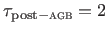 5000yr,
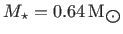 and
.
The stellar mass found here is in agreement with the
and
.
The stellar mass found here is in agreement with the
 estimate of Exter et al. (2010).
Fig.9 compares the two model atmosphere fluxes with a blackbody with
K.
estimate of Exter et al. (2010).
Fig.9 compares the two model atmosphere fluxes with a blackbody with
K.
Table 6 lists the parameters used for our final simulations in two different NTLE model atmosphere fluxes. The ionization structure of this nebula was best reproduced using these best two models. Each model has different effective temperature, stellar luminosity and abundances (N/H, O/H and Ne/H). The results of our two models are compared in Tables 7-10 to those derived from the observation and empirical analysis.
| Ion | ||||||||
| Element | I | II | III | IV | V | VI | VII | |
| H | 11696 | 12904 | ||||||
| 11470 | 12623 | |||||||
| He | 11628 | 12187 | 13863 | |||||
| 11405 | 11944 | 13567 | ||||||
| C | 11494 | 11922 | 12644 | 15061 | 17155 | 17236 | 12840 | |
| 11289 | 11696 | 12405 | 14753 | 16354 | 16381 | 12550 | ||
| N | 11365 | 11864 | 12911 | 14822 | 16192 | 18315 | 18610 | |
| 11170 | 11661 | 12697 | 14580 | 15836 | 17368 | 17475 | ||
| O | 11463 | 11941 | 12951 | 14949 | 15932 | 17384 | 20497 | |
| 11283 | 11739 | 12744 | 14736 | 15797 | 17559 | 19806 | ||
| Ne | 11413 | 11863 | 12445 | 14774 | 16126 | 18059 | 22388 | |
| 11196 | 11631 | 12215 | 14651 | 16166 | 18439 | 20488 | ||
| S | 11436 | 11772 | 12362 | 14174 | 15501 | 16257 | 18313 | |
| 11239 | 11557 | 12133 | 13958 | 15204 | 15884 | 17281 | ||
| Ar | 11132 | 11593 | 12114 | 13222 | 14908 | 15554 | 16849 | |
| 10928 | 11373 | 11894 | 13065 | 14713 | 15333 | 16392 | ||
| Torus | Spheroid | |||||||
 OIII
OIII
|
 SII
SII
|
OIII
|
SII
|
|||||
| M.1 | 12187K | 105cm
|
15569K | 58cm
|
||||
| M.2 | 11916K | 103cm
|
15070K | 58cm
|
||||
| Ion | ||||||||
| Element | I | II | III | IV | V | VI | VII | |
| Model 1 | ||||||||
| H | 6.53( )
) |
9.35( )
) |
||||||
3.65( )
) |
9.96(
) |
|||||||
| He | 1.92(
) |
7.08(
) |
2.73(
) |
|||||
3.05( )
) |
1.27(
) |
8.73(
) |
||||||
| C | 5.92(
) |
2.94(
) |
6.77(
) |
2.33(
) |
1.86(
) |
7.64( )
) |
1.00( )
) |
|
3.49( )
) |
1.97(
) |
3.97(
) |
4.50(
) |
1.33(
) |
1.09( )
) |
1.00(
) |
||
| N | 7.32(
) |
4.95(
) |
4.71(
) |
2.62(
) |
4.18(
) |
6.47( )
) |
2.76( )
) |
|
| 1.02(
) |
1.30(
) |
3.65(
) |
3.97(
) |
1.59(
) |
6.69(
) |
6.89( )
) |
||
| O | 6.15(
) |
4.98(
) |
4.21(
) |
1.82(
) |
7.09(
) |
1.34(
) |
7.28( )
) |
|
| 6.96(
) |
1.26(
) |
3.31(
) |
4.03(
) |
1.69(
) |
6.00(
) |
2.42(
) |
||
| Ne | 3.46(
) |
6.70(
) |
9.10(
) |
2.26(
) |
3.56(
) |
4.25(
) |
2.11( )
) |
|
| 1.39(
) |
3.32(
) |
3.71(
) |
3.51(
) |
2.05(
) |
6.55(
) |
4.49(
) |
||
| S | 1.13(
) |
1.67(
) |
7.75(
) |
5.52(
) |
1.15(
) |
6.20(
) |
8.53( )
) |
|
| 3.18(
) |
3.89(
) |
1.73(
) |
3.53(
) |
2.43(
) |
1.57(
) |
6.91(
) |
||
| Ar | 4.19(
) |
3.15(
) |
7.51(
) |
2.10(
) |
5.97(
) |
1.13(
) |
5.81(
) |
|
| 1.12(
) |
2.33(
) |
5.81(
) |
2.83(
) |
1.85(
) |
2.73(
) |
2.01(
) |
||
| Model 2 | ||||||||
| H | 7.94(
) |
9.21(
) |
||||||
| 4.02(
) |
9.96(
) |
|||||||
| He | 2.34(
) |
7.25(
) |
2.51(
) |
|||||
| 3.51(
) |
1.33(
) |
8.67(
) |
||||||
| C | 7.97(
) |
3.23(
) |
6.49(
) |
1.93(
) |
1.29(
) |
5.29(
) |
1.00(
) |
|
| 4.45(
) |
2.23(
) |
4.13(
) |
4.41(
) |
1.23(
) |
1.00(
) |
1.00(
) |
||
| N | 1.00(
) |
5.44(
) |
4.24(
) |
2.15(
) |
2.62(
) |
2.20(
) |
9.23( )
) |
|
| 1.31(
) |
1.52(
) |
3.84(
) |
4.07(
) |
1.50(
) |
4.40(
) |
4.34(
) |
||
| O | 7.91(
) |
5.29(
) |
3.78(
) |
1.40(
) |
4.27(
) |
2.05(
) |
6.62( )
) |
|
| 9.34(
) |
1.50(
) |
3.60(
) |
4.20(
) |
1.75(
) |
2.97(
) |
1.85(
) |
||
| Ne | 4.54(
) |
7.35(
) |
9.09(
) |
1.73(
) |
1.41(
) |
1.94(
) |
2.25( )
) |
|
| 1.75(
) |
3.85(
) |
4.19(
) |
3.86(
) |
1.89(
) |
1.73(
) |
6.89(
) |
||
| S | 1.64(
) |
1.95(
) |
7.58(
) |
4.47(
) |
7.84(
) |
3.39(
) |
3.05(
) |
|
| 4.23(
) |
4.86(
) |
1.96(
) |
3.61(
) |
2.39(
) |
1.47(
) |
5.16(
) |
||
| Ar | 7.22(
) |
3.99(
) |
7.74(
) |
1.81(
) |
3.95(
) |
5.62(
) |
1.60(
) |
|
| 1.72(
) |
3.22(
) |
7.30(
) |
3.30(
) |
1.96(
) |
2.62(
) |
1.39(
) |
||
| Model 1 | Model 2 | ||||
| Ionic ratio | Empirical | Abundance | Ionic Fraction | Abundance | Ionic Fraction |
| He
/H
|
4.80(
) |
5.308(
) |
58.97% | 5.419(
) |
60.21% |
| He
/H
|
3.60(
) |
3.553(
) |
39.48% | 3.415(
) |
37.95% |
| C
/H
|
- | 9.597(
) |
23.99% | 1.046(
) |
26.16% |
| C
/H
|
- | 2.486(
) |
62.14% | 2.415(
) |
60.38% |
| N
/H
|
1.309(
) |
9.781(
) |
40.09% | 1.007(
) |
43.58% |
| N
/H
|
- | 1.095(
) |
44.88% | 9.670(
) |
41.86% |
N /H
/H
|
- | 2.489(
) |
10.20% | 2.340(
) |
10.13% |
| O
/H
|
1.597(
) |
1.048(
) |
40.30% | 1.201(
) |
42.44% |
| O
/H
|
1.711(
) |
1.045(
) |
40.20% | 1.065(
) |
37.64% |
| O
/H
|
- | 2.526(
) |
9.72% | 2.776(
) |
9.81% |
| Ne
/H
|
- | 6.069(
) |
5.47% | 6.571(
) |
5.92% |
| Ne
/H
|
1.504(
) |
8.910(
) |
80.27% | 9.002(
) |
81.10% |
| Ne
/H
|
- | 1.001(
) |
9.02% | 1.040(
) |
9.37% |
S
/H

|
2.041(
) |
2.120(
) |
13.50% | 2.430(
) |
15.48% |
| S
/H
|
1.366(
) |
1.027(
) |
65.44% | 1.013(
) |
64.55% |
| S
/H
|
- | 1.841(
) |
11.73% | 1.755(
) |
11.18% |
| Ar
/H
|
- | 3.429(
) |
2.54% | 4.244(
) |
3.14% |
| Ar
/H
|
1.111(
) |
8.271(
) |
61.26% | 8.522(
) |
63.13% |
| Ar
/H
|
4.747(
) |
3.041(
) |
22.52% | 2.885(
) |
21.37% |
Ar /H
/H
|
- | 5.791(
) |
4.29% | 5.946(
) |
4.40% |
Ar /H
/H
|
- | 7.570(
) |
5.61% | 7.221(
) |
5.35% |
Shock excitation largely enhances the S
/H
ionic abundance ratio.
Table 7 compares the flux intensities calculated by our models with those from the observations. The fluxes are given relative to H
, on a scale where H . Most predicted line fluxes from each model are in fairly good agreement with the observed values and the two models produce very similar fluxes for most observed species. There are still some discrepancies in the few lines, e.g.
O II
3726,3729 and
S II
6716,6731.
The discrepancies in
O II
3726,3729 can be
explained by either recombination contributions or intermediate phase
caused by a complex density distribution (see e.g. discussion
in Ercolano et al., 2003c).
S II
6716,6731 was affected by shock-ionization and its
true flux intensity is much lower without the shock fronts. Meanwhile,
Ar III
7751 was enhanced by the telluric line. The recombination
line H
. Most predicted line fluxes from each model are in fairly good agreement with the observed values and the two models produce very similar fluxes for most observed species. There are still some discrepancies in the few lines, e.g.
O II
3726,3729 and
S II
6716,6731.
The discrepancies in
O II
3726,3729 can be
explained by either recombination contributions or intermediate phase
caused by a complex density distribution (see e.g. discussion
in Ercolano et al., 2003c).
S II
6716,6731 was affected by shock-ionization and its
true flux intensity is much lower without the shock fronts. Meanwhile,
Ar III
7751 was enhanced by the telluric line. The recombination
line H 4102 and He II
5412 were also blended
with the O II recombination lines. There are also some recombination contributions in the
O II
7320,7330 doublet.
Furthermore, the discrepancies in the faint auroral line [N II]
5755 and [O III]
4363 can be explained by the recombination excitation contribution (see section 3.3 in Liu et al., 2000).
4102 and He II
5412 were also blended
with the O II recombination lines. There are also some recombination contributions in the
O II
7320,7330 doublet.
Furthermore, the discrepancies in the faint auroral line [N II]
5755 and [O III]
4363 can be explained by the recombination excitation contribution (see section 3.3 in Liu et al., 2000).
Table 8 represents mean electron
temperatures weighted by ionic abundances for Models 1 and 2, as well as the ring region and the
inside region of the PN. We also see each ionic temperature
corresponding to the temperature-sensitive line ratio of a specified
ion. The definition for the mean temperatures was given in
Ercolano et al. (2003b); and in detail by Harrington et al. (1982).
Our model results for
O III
compare well with the value
obtained from the empirical analysis in
§4. Fig. 11 (top left) shows
 obtained for Model 2 (adopted best-fitting model)
constructed in
cubic grids, and with the ionizing
source being placed in the corner. It replicates the situation where
the inner region has much higher
in comparison to the ring
as previously found by plasma diagnostics in
§4. In particular the mean values of
O III
for the ring (torus of the actual nebula) and
the inside (spheroid) regions are around
obtained for Model 2 (adopted best-fitting model)
constructed in
cubic grids, and with the ionizing
source being placed in the corner. It replicates the situation where
the inner region has much higher
in comparison to the ring
as previously found by plasma diagnostics in
§4. In particular the mean values of
O III
for the ring (torus of the actual nebula) and
the inside (spheroid) regions are around  and
and
 K in all two models, respectively. They can be compared to
the values of Table 4 that is
O III
K in all two models, respectively. They can be compared to
the values of Table 4 that is
O III![$ ]=12 300$](img370.png) K (ring) and
K (ring) and
 K
(interior). Although the average temperature of
N II
K
(interior). Although the average temperature of
N II
![$ ]\simeq11 700$](img372.png) K
over the entire nebula is higher than that given in
Table 4, the average temperature of
O III
K
over the entire nebula is higher than that given in
Table 4, the average temperature of
O III
![$ ]\simeq13,000$](img373.png) K is in decent agreement with that found
by our plasma diagnostics.
K is in decent agreement with that found
by our plasma diagnostics.
It can be seen in Table 4 that the temperatures for the two main regions of the nebula are very different, although we assumed a homogeneous elemental abundance distribution for the entire nebula relative to hydrogen. The temperature variations in the model can also be seen in Fig. 11. The gas density structure and the location of the ionizing source play a major role in heating the central regions, while the outer regions remain cooler as expected. Overall, the average electron temperature of the entire nebula increases by increasing the helium abundance and decreasing the oxygen, carbon and nitrogen abundances, which are efficient coolants. We did not include any dust grains in our simulation, although we note that a large dust-to-gas ratio may play a role in the heating of the nebula via photoelectric emissions from the surface of grains.
Results for the fractional ionic abundances in the ring (torus) and
inner (oblate spheroid) regions of our two models are shown in
Table 9 and Fig. 11. It is
clear from the figure and table that the ionization structures from
the models vary through the nebula due to the complex density and
radiation field distribution in the gas.
As shown in Table 9 , He
/He is much
higher in the inner regions, while He
/He is larger in the
outer regions, as expected. Similarly, we find that the higher
ionization stages of each element are larger in the inner
regions. From Table 9 we see that hydrogen
and helium are both fully ionized and neutrals are less than 8% by number in these best-fitting models. Therefore, our assumption of
 is correct in our empirical method.
Table 10 lists the nebular average ionic
abundance ratios calculated from the photoionization models. The
values that our models predict for the helium ionic ratio are fairly comparable with those from
the empirical methods given in §5,
though there are a number of significant differences in other ions.
The O
/H
ionic abundance ratio is about 33 per cent lower,
while O
/H
is about 60% lower in Model 2 than the empirical
observational value.
The empirical value of S
differs by a factor of 8 compared to our result in Model 2,
explained by the shock-excitation effects on the
S II
6716,6731 doublet.
Additionally, the Ne
/H
ionic abundance ratio was underestimated by roughly 67% in
Model 2 compared to observed results, explained by the properties of the ionizing source.
The Ar /H
ionic abundance ratio in Model 2 is 56% lower than the empirical results.
Other ionic fractions do not show major discrepancies; differences remain below 35%.
We note that the N
/N ratio is roughly equal to the O
/O
ratio, similar to what is generally assumed in the
(N)
method. However, the Ne
/Ne ratio is nearly a factor of 2
larger than the O
/O ratio, in contrast to the general
assumption for
(Ne) (see equation 5). It has
already been noted by Bohigas (2008) that an alternative
ionization correction method is necessary for correcting the unseen
ionization stages for the neon abundance.
/H
ionic abundance ratio in Model 2 is 56% lower than the empirical results.
Other ionic fractions do not show major discrepancies; differences remain below 35%.
We note that the N
/N ratio is roughly equal to the O
/O
ratio, similar to what is generally assumed in the
(N)
method. However, the Ne
/Ne ratio is nearly a factor of 2
larger than the O
/O ratio, in contrast to the general
assumption for
(Ne) (see equation 5). It has
already been noted by Bohigas (2008) that an alternative
ionization correction method is necessary for correcting the unseen
ionization stages for the neon abundance.
In Fig. 10 we compared the values of the effective
temperature
and luminosity
obtained from our
two models listed in Table 6 to
evolutionary tracks of hydrogen-burning and helium-burning
models calculated by Blöcker (1995). We compared the
post-AGB age of these different models with the dynamical age of the
ring found in §3. The kinematic analysis
indicates that the nebula was ejected about 23400-26300 yr ago.
The post-AGB age of the hydrogen-burning model (left-hand panel in
Fig. 10) is considerably shorter than the nebula's age, suggesting that the helium-burning model (VLTP; right-hand panel in Fig. 10) may be favoured to explain the age.
The physical parameters of the two A-type stars also yield a further constraint. The stellar evolutionary tracks
of the rotating models for solar metallicity calculated by Ekström et al. (2012) imply that the A-type stars, both
with masses close to
 and
and
 K, have ages of
  Myr. We see that they are in the evolutionary phase of the ``blue hook''; a very short-lived phase just before the Hertzsprung gap. Interestingly, the initial mass of
 found for the ionizing source has the same age. As previously suggested by Exter et al. (2010), the PN progenitor with an initial mass slightly greater than
can be coeval with the A-type stars, and it recently left the AGB phase. But, they adopted the system age of about 520 Myr according to the Y
found for the ionizing source has the same age. As previously suggested by Exter et al. (2010), the PN progenitor with an initial mass slightly greater than
can be coeval with the A-type stars, and it recently left the AGB phase. But, they adopted the system age of about 520 Myr according to the Y evolutionary tracks (Demarque et al., 2004; Yi et al., 2003).
The effective temperature and stellar luminosity obtained for both models correspond to the progenitor mass of
.
However, the strong nitrogen enrichment seen in the nebula is inconsistent with this initial mass, so
another mixing process rather than the hot-bottom burning (HBB) occurs at substantially lower initial
masses than the stellar evolutionary theory
suggests for AGB-phase
(Karakas et al., 2009; Herwig, 2005; Karakas & Lattanzio, 2007). The stellar models developed by Karakas & Lattanzio (2007)
indicate that HBB occurs in intermediate-mass AGB stars with the initial mass of
 for the metallicity of
  ; and
; and
 for
for  -
- . However, they found that
a low-metallicity AGB star (
. However, they found that
a low-metallicity AGB star ( ) with the progenitor mass of
can also
experience HBB. Our determination of the argon abundance in SuWt 2 (see Table6) indicates that it does not belong to the low-metallicity stellar population; thus, another non-canonical mixing process made the abundance pattern of this PN.
) with the progenitor mass of
can also
experience HBB. Our determination of the argon abundance in SuWt 2 (see Table6) indicates that it does not belong to the low-metallicity stellar population; thus, another non-canonical mixing process made the abundance pattern of this PN.
The stellar evolution also depends on the chemical composition of the progenitor, namely the helium content ( ) and the metallicity (
 ), as well as the efficiency of convection (see e.g. Salaris & Cassisi, 2005). More helium increases the H-burning efficiency, and more metallicity makes the stellar structure fainter and cooler. Any change in the outer layer convection affects the effective temperature. There are other non-canonical physical processes such as rotation, magnetic field and mass-loss during Roche lobe overflow (RLOF) in a binary system, which significantly affect stellar evolution. Ekström et al. (2012) calculated a grid of stellar evolutionary tracks with rotation, and found that N/H at the surface in rotating models is higher than non-rotating models in the stellar evolutionary tracks
until the end of the central hydrogen- and helium-burning phases prior to the AGB stage. The Modules for Experiments in Stellar Astrophysics (MESA) code developed by Paxton et al. (2013); Paxton et al. (2011) indicates that an increase in the rotation rate (or angular momentum) enhances the mass-loss rate. The rotationally induced and magnetically induced mixing processes certainly influence the evolution of intermediate-mass stars, which need further studies by MESA. The mass-loss in a binary or even triple system is much more complicated than a single rotating star, and many non-canonical physical parameters are involved (see e.g. BINSTAR code by Siess et al., 2013; Siess, 2006). Chen & Han (2002) used the Cambridge stellar evolution (STARS) code developed by Eggleton (1973); Eggleton (1971); Eggleton (1972) to study numerically evolution of Population I binaries, and produced a helium-rich outer layer. Similarly, Benvenuto & De Vito (2005); Benvenuto & De Vito (2003) developed a helium white dwarf from a low mass progenitor in a close binary system. A helium enrichment in the our layer can considerably influence other elements through the helium-burning mixing process.
), as well as the efficiency of convection (see e.g. Salaris & Cassisi, 2005). More helium increases the H-burning efficiency, and more metallicity makes the stellar structure fainter and cooler. Any change in the outer layer convection affects the effective temperature. There are other non-canonical physical processes such as rotation, magnetic field and mass-loss during Roche lobe overflow (RLOF) in a binary system, which significantly affect stellar evolution. Ekström et al. (2012) calculated a grid of stellar evolutionary tracks with rotation, and found that N/H at the surface in rotating models is higher than non-rotating models in the stellar evolutionary tracks
until the end of the central hydrogen- and helium-burning phases prior to the AGB stage. The Modules for Experiments in Stellar Astrophysics (MESA) code developed by Paxton et al. (2013); Paxton et al. (2011) indicates that an increase in the rotation rate (or angular momentum) enhances the mass-loss rate. The rotationally induced and magnetically induced mixing processes certainly influence the evolution of intermediate-mass stars, which need further studies by MESA. The mass-loss in a binary or even triple system is much more complicated than a single rotating star, and many non-canonical physical parameters are involved (see e.g. BINSTAR code by Siess et al., 2013; Siess, 2006). Chen & Han (2002) used the Cambridge stellar evolution (STARS) code developed by Eggleton (1973); Eggleton (1971); Eggleton (1972) to study numerically evolution of Population I binaries, and produced a helium-rich outer layer. Similarly, Benvenuto & De Vito (2005); Benvenuto & De Vito (2003) developed a helium white dwarf from a low mass progenitor in a close binary system. A helium enrichment in the our layer can considerably influence other elements through the helium-burning mixing process.